

Peace Industry Co., Ltd., whose flagship product is the PEACE-LON oil-impregnated bearing for small motors used in home appliances, office automation equipment, and automobiles, has refined its powder-metallurgy technology since its founding in 1961. The company’s strength lies in an integrated in-house system spanning raw-material R&D, equipment design, and die manufacturing, enabling technical proposals tailored to each customer’s challenges.
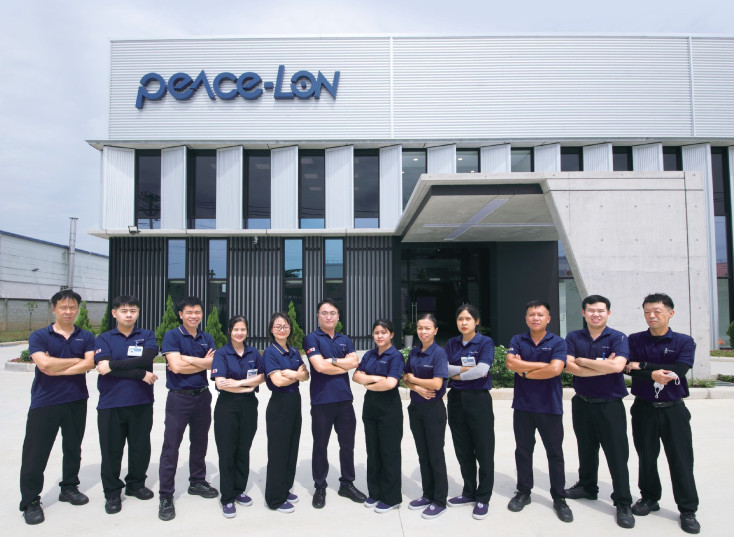
Peace Industry Co., Ltd., whose flagship product is the PEACE-LON oil-impregnated bearing for small motors used in home appliances, office automation equipment, and automobiles, has refined its powder-metallurgy technology since its founding in 1961. The company’s strength lies in an integrated in-house system spanning raw-material R&D, equipment design, and die manufacturing, enabling technical proposals tailored to each customer’s challenges. In 2026, it opened a new plant in Vietnam in the former Long An Province, now part of Tay Ninh Province, and is building up its mass-production system. We spoke with Mr. Otake, Executive Managing Director at the Japan headquarters and head of the local subsidiary, and Mr. Honda, who oversees overseas sales, about the company’s manufacturing approach and future outlook.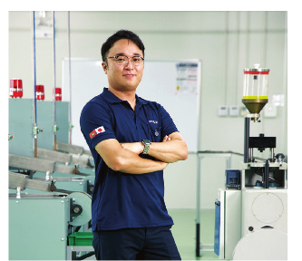
Mr. Otake, head of the local subsidiary.
Technical Proposals Starting from Customer Challenges
The most common inquiries Peace Industry receives concern cost reduction. Oil-impregnated bearings require fewer machining processes than precision-cut components such as ball bearings and can therefore be produced at lower cost, making them widely used as substitute parts. Customers often ask whether a ball bearing can be replaced by an oil-impregnated bearing, and the company itself also frequently proposes changing the manufacturing method. The same applies beyond bearings. Gears, for example, are generally produced by machining, but with powder metallurgy they can be formed in a die to near-net shape. This reduces machining processes and material loss, ultimately lowering cost.
These proposals are supported by a broad lineup of raw materials and strong materials-development capabilities. The company handles more than 60 types of powder materials, including iron-based, copper-based, and iron-copper materials. While many competitors simply form pre-mixed materials, Peace Industry can take advantage of the characteristics of the raw materials themselves and design and propose the material composition.
Mr. Otake explains: 'With oil-impregnated bearings, even a small difference in composition affects quietness. Adding a little more copper raises cost, but it also makes the bearing quieter. Our strength is that we can design the material blend to match the performance the customer requires.'
This materials-design know-how is also used when selecting the oil impregnated into the bearing. The company works jointly with oil manufacturers to develop oils that maintain performance at low temperatures or resist evaporation at high temperatures, and selects the optimum viscosity for each application.
Quality Is Built on the Shop Floor
The company’s technical foundation is powder-metallurgy manufacturing. Metal powder is compacted in a die and then heated at high temperature in a sintering process. The company performs the entire sequence in-house—from raw-material formulation and mixing through forming, sintering, sizing, oil impregnation, and final inspection—to manufacture small precision components.
'Our equipment is extremely sensitive. Even when we manufacture under the same conditions, the result changes depending on the day’s temperature and humidity and even the condition of individual iron-powder particles,' says Mr. Otake.
For that reason, simply managing process conditions is not enough to stabilize quality.
'Even when we manufacture exactly according to the prescribed conditions, variation can occur along the way. It is important to make fine adjustments while observing the condition of the product at each process and to build quality into every step ourselves.'
The powder-metallurgy expertise Peace Industry has accumulated over many years is now being carried over from Japan to the new Vietnam plant.
A Proprietary Material Born from Problem-Solving
A symbol of the company’s materials-development capabilities is its proprietary material FCS-500. It was created in response to a customer who said: 'Copper is necessary, but it is expensive, so we want to reduce the amount used.' Copper is an important material in oil-impregnated bearings because it affects sliding performance and quietness, but simply reducing the copper content lowers performance. Peace Industry therefore developed FCS-500, a material in which only the surface of the iron powder is coated with copper. By retaining the wear resistance of iron while positioning copper at the sliding surface, the material combines quietness with lower cost.
FCS-500 can reduce the copper component by around 20% while still utilizing copper’s characteristics, helping control cost at the same time. The formulation can also be customized—for example, by adjusting the amount of copper around the FCS-500 base—to match required quality and cost. With copper prices continuing to rise, adoption is expanding across a wide range of fields as a VA material unique to Peace Industry.
The underlying technology of coating the surface of iron powder with copper had existed for some time, but the company’s technical strength lies in establishing it as a mass-production technology. According to Mr. Otake, the theme was initially viewed internally as difficult to realize, but the engineering team persisted with research and ultimately brought it into practical use.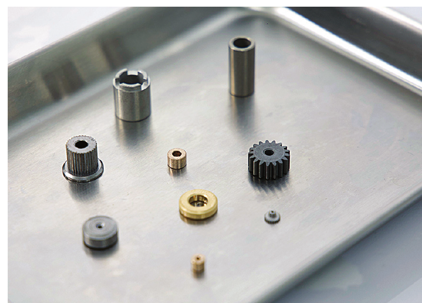
The company specializes in small powder-metallurgy products from 0.5 mm to 22 mm.
In-House Capabilities Accelerate Development
To propose the optimum material and manufacturing method for each customer, prototypes and improvements must be repeated over short cycles. In-house production of dies and production equipment makes that possible.
Mr. Otake says: 'When people hear the word die, many imagine a large press die, but even our largest dies are only about the size of an index finger.'
Minute differences in die dimensions or fit can affect burr formation and dimensional accuracy. For that reason, the company repeatedly makes fine corrections while evaluating prototypes until it reaches the optimum geometry.
'If we had to keep going back and forth with an outside die maker—make it once, then ask for a small correction—our development speed could not keep up. That is why we make and adjust the dies in-house.'
The same approach applies to production equipment. Since its founding, the company has continued to develop and improve equipment internally, allowing it to modify machines in response to customer requirements while raising both productivity and quality.
An integrated system covering everything from raw-material development and die making to mass production supports the company’s ability to respond rapidly to diverse requirements.
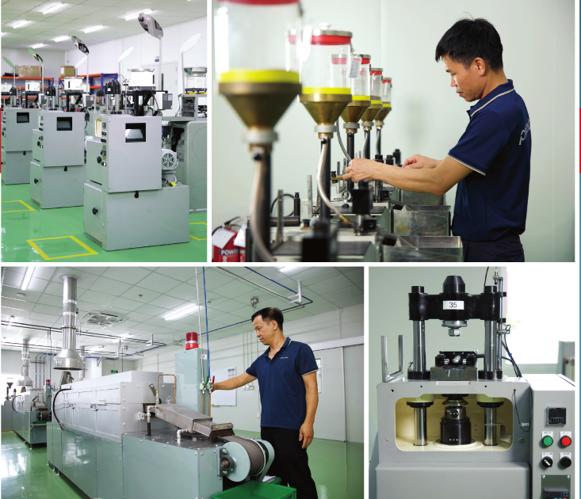
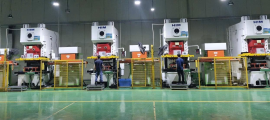
Much of the production equipment is designed in-house. Japan, China, and the Vietnam plant use the same self-designed equipment, helping maintain consistent products and quality across locations.
Reproducing Japanese Quality in Vietnam
Reproducing in Vietnam the same quality developed in Japan was the biggest theme in launching the new plant. To maintain Japanese quality in a hot and humid environment, air conditioning is controlled from the raw-material warehouse through the production process so that temperature and humidity remain within internal standards.
The company is also investing heavily in human-resource development. It is currently recruiting mainly management candidates and inspectors. For management-track positions, it actively hires people who have worked in Japan under technical-intern or specified-skilled-worker programs, enabling smoother transfer of technical and quality-management know-how. Mr. Otake also believes that qualities often seen in Vietnamese workers—diligence and dexterity—fit powder-metallurgy production, which requires delicate adjustment.
The new plant is located in Tay Ninh Province (formerly Long An Province). Its location near Ho Chi Minh City makes it easier to procure raw materials from Japan and offers good access to ports, allowing the site to function as an export base not only for Thailand and Indonesia but also for India.
Anticipating growing demand for more complex geometries, the plant has introduced a large press. In addition to the motor bearings and gears that have been the company’s main products, Peace Industry plans to expand into sintered components for automobiles, motorcycles, and other applications beyond motors. The Vietnam plant will therefore serve both as a high-quality mass-production base and as a place to challenge new product fields.
Expanding the Business Across the ASEAN Market
At the Vietnam plant, products currently made in Japan and China will be transferred in stages while the company develops new markets. Its main customers to date have been Japanese-affiliated manufacturers, but it also plans to expand business with Korean-affiliated manufacturers and Vietnamese companies. Beyond supplying individual parts, the company intends to make higher-value proposals, such as delivering components already assembled into motors. It also aims to build a locally completed supply chain by expanding cooperation with Vietnamese companies handling processes such as heat treatment and surface treatment. There are still relatively few sintered-parts manufacturers in Vietnam, and Peace Industry intends to use its ability to propose from the material and process stage to create more customer touchpoints.
As an immediate goal, Mr. Otake is aiming for full operation of the Vietnam plant. Beyond that is the optimization of roles within the group: Japan as the development base for creating new equipment and materials; China as the base for strengthening sales functions and technical support; and Vietnam as the mass-production base supporting ASEAN expansion. A structure that makes use of each location’s strengths will shape Peace Industry’s next decade.