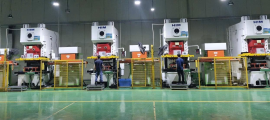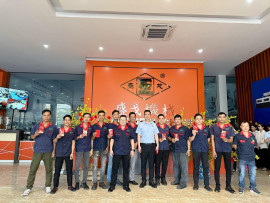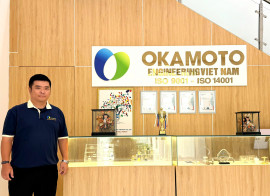


Kamogawa Vietnam Co., Ltd. entered Vietnam in 2004 and has expanded its business around the supply of industrial products, including cutting tools. Today, their activities extend to the sale of machine tools, robots, and their own-brand products, as well as custom tool manufacturing and regrinding at their own factory and equipment maintenance.
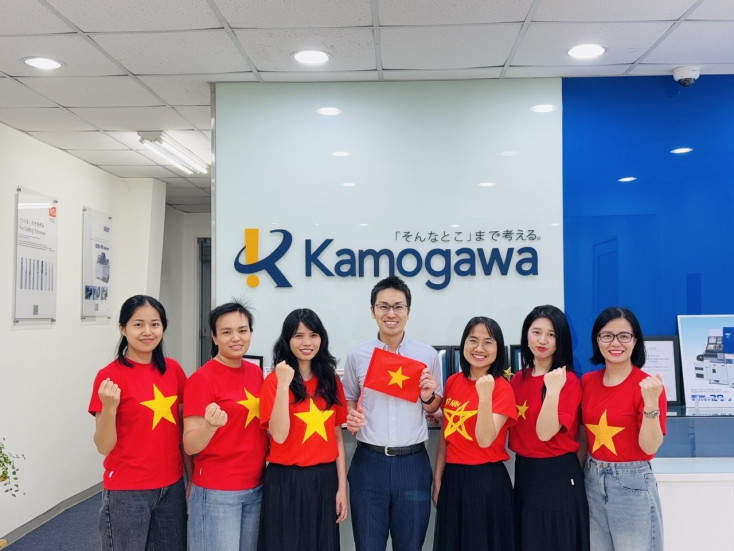
Kamogawa Vietnam Co., Ltd. entered Vietnam in 2004 and has expanded its business around the supply of industrial products, including cutting tools. Today, its activities extend to the sale of machine tools, robots, and its own-brand products, as well as custom tool manufacturing and regrinding at its own factory and equipment maintenance. In recent years, it has also focused on factory automation (FA), strengthening its position as a trading company that provides technical services. We spoke with President Daisuke Nakauchi and his colleagues about the company’s strategy and competitive strengths as it evolves alongside Vietnam’s manufacturing industry, and their expectations for the FBC ASEAN manufacturing business matching event in September 2026.
Customer needs have driven business expansion
For more than 20 years, Kamogawa Vietnam has expanded its business by responding to customer requests one by one.
Initially, its core business was supplying industrial products such as tools. As its involvement with manufacturing sites deepened, more customers began asking for machinery and for support with installation and maintenance. The company moved into machinery sales and established the capabilities needed to provide those services.
“Once you handle machinery, you need an in-house capability that goes beyond sales to cover maintenance and installation. That is why we began combining our products with technical services at an early stage,” Nakauchi recalls.
In 2013, the company opened its own factory. Manufacturing custom tools and providing regrinding services locally enabled it to offer both shorter lead times and lower costs. It also handles the regrinding of carbide and diamond tools, bringing machining expertise developed in Japan to Vietnam.
More recently, the company has invested in robot-based factory automation. Its in-house robot engineers and design engineers handle robot teaching, programming, and conceptual design for automated machinery. Its role extends beyond selling products to supporting improvements across the production floor.
“Let’s keep taking on whatever our customers need.” This attitude has greatly broadened Kamogawa Vietnam’s scope of business.
Products, technical expertise, and logistics for greater productivity
Productivity improvement is now the subject of the largest number of inquiries Kamogawa Vietnam receives.
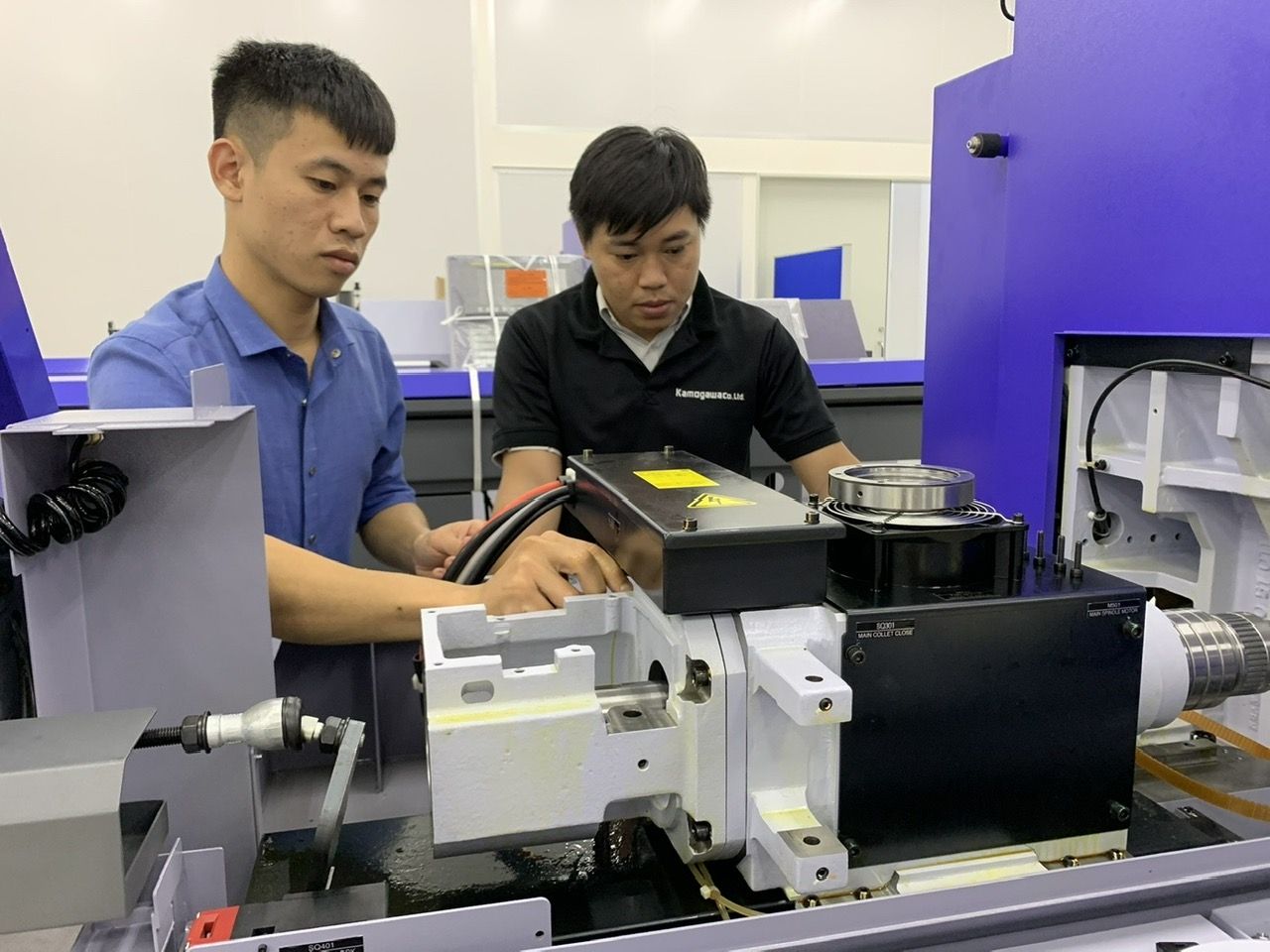
Manufacturers’ needs are becoming more diverse and demanding each year, ranging from labor shortages and quality improvement to shorter machining times and lower costs.
Rather than recommending equipment or tools individually, the company assesses the entire production floor to identify the most suitable combination. Its broad product portfolio underpins this approach. Some processes can be improved by changing cutting tools, while others benefit from upgraded machine tools or the introduction of robots. By also incorporating custom tool manufacturing, regrinding, and equipment maintenance, it works to improve efficiency across the production line. In Vietnam, the company offers three own brands: KAMOG, covering a broad range of industrial products; DIAMANT, for electroplated diamond tools; and KAMOSOL, specializing in cutting tools. These proprietary products further broaden the options it can offer customers.
“We are constantly proposing ways to improve productivity by making use of new technologies and products,” says Nakauchi.
Logistics is another priority. Drawing on its sourcing capabilities in Japan, the company has built a transport network that combines air and sea freight. It provides inventory management for non-export-processing companies (Non-EP) and bonded warehousing services for export-processing companies (EP), tailoring its logistics services to each customer’s business model. By managing procurement, delivery, and inventory as an integrated service, it supports stable production.
The company covers Vietnam through four locations: Hanoi, Hai Phong, Da Nang, and Ho Chi Minh City. It has six Japanese employees—four in Hanoi and two in Ho Chi Minh City—and 14 Vietnamese sales staff across its locations, with a total workforce of approximately 60. Collaboration with its Japanese operation and group companies enables it to handle a wide range of projects.
“Our broad product range, technical services, and logistics are our three major strengths.”
What distinguishes Kamogawa Vietnam is not simply its ability to supply products, but its ability to combine these strengths into proposals that meet customers’ needs.
An expanding market brings new business opportunities
Japanese companies currently account for approximately 80% of its customers. In recent years, however, business with local Vietnamese companies has also been growing. Its customer base, traditionally centered on the automotive and motorcycle industries, is now expanding into semiconductor manufacturing equipment and electronic components.
Growing demand for AI and data centers is driving investment in the semiconductor market worldwide. This trend has reached Vietnam, bringing more inquiries from related companies. High-precision components that would previously have been machined overseas are increasingly being produced within Vietnam. The metalworking skills and expertise developed through serving Japanese manufacturers are also proving valuable in these fields.
The automotive and motorcycle industries nevertheless remain important markets supporting Vietnamese manufacturing. Although their period of rapid expansion has eased, demand remains resilient, and many companies are building on their established businesses while branching out into new fields.
A market where price alone no longer determines the choice
As business opportunities broaden and Vietnam’s manufacturing industry develops, the value expected of trading companies is also changing. Price once tended to dominate purchasing decisions. In recent years, however, customers have increasingly valued comprehensive proposals that improve productivity, quality, and equipment utilization.
“In the past, decisions were often based solely on the initial cost. Recently, more customers have been taking tool life and productivity into account as well,” Nakauchi says.
Competition, meanwhile, is intensifying year by year. Alongside Chinese manufacturers, Indian-made machine tools and cutting tools have also become more price-competitive in recent years. Being made in Japan is no longer enough to ensure a product is chosen. This makes the ability to identify the right solution for each customer all the more important.
“Technical expertise, the ability to propose solutions, and management capabilities are becoming more important in this market. For companies with accumulated experience, I feel it is actually becoming a market where they can compete more effectively.”
An automation business developed in Vietnam expands to Japan
One illustration of the company’s technical expertise and ability to develop solutions is the rapid growth of its FA business. This business began in Vietnam, rather than Japan, during the COVID-19 pandemic. Labor shortages and growing interest in reducing labor requirements led to a sharp increase in inquiries about robot-based automation. At the time, however, the company had very little expertise in factory automation.
“For the first year or two, we had limited knowledge, and things did not go smoothly. Even so, we stayed committed to proposing solutions built around technical services, and developed the business in cooperation with robot manufacturers and Vietnamese companies.”
As the business progressed, the company also trained its own specialists, enabling it to handle everything from conceptual design and robot teaching to equipment commissioning in-house.
“As we began to see results in Vietnam, the FA business also got fully underway in Japan in 2026. It is one of the businesses that originated in Vietnam,” says Nakauchi.
People and a showroom underpin technical capabilities
Employee development and the company’s showroom support the growth of its FA business.
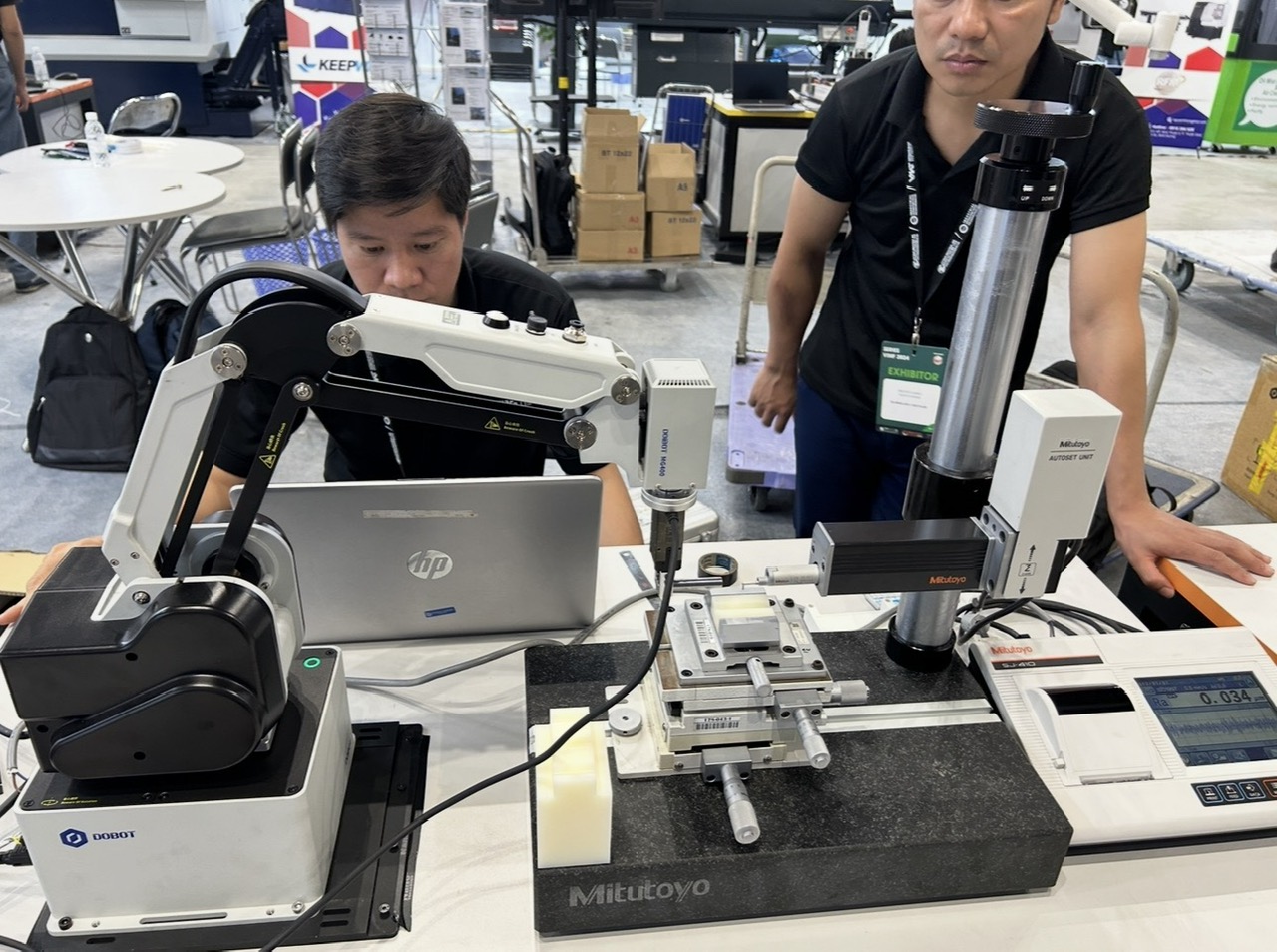
In the early days, Japanese staff provided technical guidance at the factory. Now, nearly a quarter of a century after the company began operations, Vietnamese staff play the central role in running production. Vietnamese engineers who have returned after gaining experience in automated machine design or working for manufacturers in Japan are also applying their specialist knowledge in the sales department.
“Our Vietnamese staff now train the next generation themselves. I see this as a major asset we have built over more than 20 years.”
The other pillar is the showroom in Hanoi, where customers can experience equipment and technologies firsthand. It displays machine tools, measuring equipment, robots, and automated machinery. Rather than simply displaying products, it provides an environment where equipment can be operated for trial production and demonstrations.
Robots are displayed with teaching already completed, helping customers gain a concrete understanding of how they could use them after installation. The company also provides operating training for customers introducing such equipment for the first time.
The showroom serves both as a venue for sales activities and as a training base. Building knowledge through hands-on experience with actual equipment also strengthens collaboration between sales and technical staff.
The company is focusing on FBC ASEAN as an opportunity to bring the hands-on approach it has developed in its showroom—allowing customers to see, touch, and experience its solutions—to a wider range of businesses.
Showcasing Kamogawa Vietnam’s evolution at FBC ASEAN
Kamogawa Vietnam has exhibited regularly at FBC ASEAN. For 2026, it is substantially revamping its exhibits.
“We decided on this year’s exhibits because we want visitors to learn about our equipment and automation initiatives, as well as our tools,” says Daisuke Katsura, head of the Hanoi sales office.
Its booth will feature machine tools, automated deburring equipment, filtration equipment for wastewater treatment, industrial robots, and collaborative robots.
The automated deburring equipment removes burrs after machining, helping manufacturers address labor shortages and achieve more consistent quality. Once a workpiece is loaded, processing takes approximately 10 seconds, reducing the burden of manual work.
The wastewater filtration system filters cutting and grinding fluids, separating out sludge to produce clean water for discharge. It uses a filter-based process without chemicals, helping reduce industrial waste disposal costs and maintenance requirements. The company also provides demonstration units, testing them with customers’ own wastewater to assess the benefits before recommending the most suitable equipment.
The robot exhibits will include industrial robots from a Japanese manufacturer and collaborative robots from a Chinese manufacturer. Alongside offering choices suited to different applications and budgets, the company aims to implement automation as a complete system, including peripheral equipment, rather than supplying robots alone.
Katsura describes FBC ASEAN as “an exhibition that is an excellent fit for us.” He believes its broad mix of Japanese and Vietnamese companies gives Kamogawa Vietnam an ideal opportunity to demonstrate its ability to propose solutions.
“We cannot reach every customer on our own. Simply discovering at an exhibition that equipment like this exists can lead to subsequent inquiries or improvements to a production facility. We look forward to reconnecting with existing customers and meeting companies with whom we have had no previous contact,” he says. Yuta Komatsuda, who is responsible for the FA business, adds: “This time, we will demonstrate our capabilities as a trading company that handles not only small products but also equipment. As the Vietnamese market continues to grow, I believe this exhibition will provide an important opportunity for our next stage of growth.”
Kamogawa Vietnam continues to evolve as a comprehensive supplier of industrial products. At FBC ASEAN, it will showcase the breadth of the solutions it can offer.