

For the first time, Oppo surpassed Samsung to claim the top spot in Vietnam's smartphone market share in Q2/2024, according to a report from Canalys.
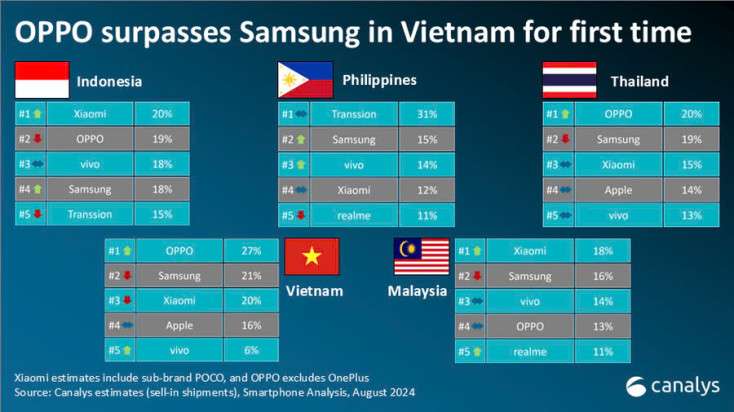
Market research firm Canalys reported that the Chinese smartphone company experienced 110% growth compared to the same period last year, reaching a 27% market share. This put Oppo ahead of Samsung (21%), Xiaomi (20%), Apple (16%), and Vivo (6%).
Among the top five in Vietnam, Samsung was the only brand to experience negative growth, with a 24% decline. The most significant increase came from Vivo, which surged by 122%.
IDC's statistics also paint a similar picture for the past quarter, with Oppo holding 26.9% market share, Samsung 21.7%, and Apple 14.1%.
The figures from Canalys and IDC are based on "sell-in" data for Q2/2024. Sell-in represents the number of smartphones shipped from the manufacturer to the distributor, as opposed to sell-out, which tracks the number of smartphones sold from the distributor to the end consumer. While sell-in and sell-out figures aren't identical, they are correlated, as retail stores need to sell their existing inventory before ordering more to avoid overstock.
These surprising figures come after Samsung had led the Vietnamese market for many years with a significant gap over other brands. In Q1/2024, Samsung held 28%, far ahead of Xiaomi's 19%, while Oppo and Apple had 18%. In Q4/2023, the South Korean giant reached a 31% market share, surpassing Apple's 21%, with Oppo in fourth place at 16%.
According to Canalys, the Southeast Asian smartphone market grew by 14% year-on-year, reaching 23.9 million units. Samsung saw a slight recovery after seven consecutive quarters of year-on-year decline, shipping 4.4 million units. Oppo secured the second position in Southeast Asia with 3.2 million units, accounting for 17% market share.
"The recovery of the Southeast Asian smartphone market has been driven by macroeconomic improvements and positive consumer sentiment," said Canalys analyst Le Xuan Chiew.
Additionally, the premium segment, priced above 600 USD, also gained attention with an 18% increase. Samsung led this segment by adjusting its global strategy to focus on high-end models. The company made significant investments in AI, along with the launch of new products such as the Galaxy Z Fold6, Z Flip6, and S24. Apple also saw a 15% increase thanks to its efforts to expand retail operations in Vietnam and Malaysia, as well as Tim Cook's visit to several countries in the region earlier this year.
However, Canalys analyst Sheng Win Chow warned that currency exchange rate fluctuations could significantly impact the market and pose challenges for suppliers. The low-cost segment, led by Chinese brands, is more "sensitive" to these changes. In most Southeast Asian countries, leading positions are dominated by Chinese brands like Oppo and Xiaomi.