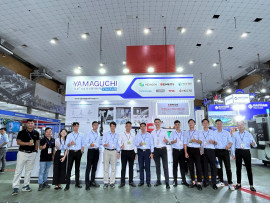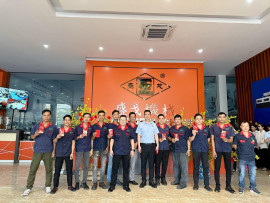


Why would a company that has already brought Japanese quality to Vietnam establish a facility in Central Vietnam at this time? We listened to the CEO of Ohnoseiko, Mr. Ryutaro Ohno, and the CEO of Ohnoseiko Vietnam, Mr. Phan Binh Duong, about the background and objectives.
Ohnoseiko Vietnam Opens Second Factory in Hoi An Two Facilities Open the Next Phase of Growth
More than ten years have passed since Ohnoseiko Vietnam began operations near Ho Chi Minh City in 2013. Specializing in precision machining, Ohnoseiko Vietnam officially commenced operations at its second factory in Hoi An, Central Vietnam, in January 2026. This investment is not simply aimed at increasing production capacity. By clearly defining the roles of the factories in Ho Chi Minh City and Hoi An and expanding the service area, the company is building a system geared towards nationwide development. Why would a company that has already brought Japanese quality to Vietnam establish a facility in Central Vietnam at this time? We listened to the CEO of Ohnoseiko, Mr. Ryutaro Ohno, and the CEO of Ohnoseiko Vietnam, Mr. Phan Binh Duong, about the background and objectives.
Rising land prices and site reconsideration
The direct impetus for building the second factory was the lack of space at the Ho Chi Minh City factory. Although there were plans for expansion and relocation to meet future production demands, these plans were repeatedly delayed due to issues related to the industrial park. During this time, land prices in the surrounding area skyrocketed, a project initially launched at around $120/m² had risen to $250/m².
"Expanding in Ho Chi Minh City is no longer a viable option," CEO Duong said, waving his hand. The factors forcing a reassessment weren't limited to land conditions and profitability. Since participating in the Hanoi trade fair, they had attracted more customers than expected, recognizing the enormous potential of the market. On the other hand, the distance from their southern base to the north was inconvenient for customers. Furthermore, with increasingly fierce price competition from Chinese companies, they needed to find a more cost-effective location.
That's when the area around Da Nang in central Vietnam emerged as a potential candidate. Situated between Hanoi and Ho Chi Minh City, it easily served customers in both the north and south. When considering future nationwide expansion, a favorable geographical balance is a key factor to make decisions.
The person who promoted this choice was CEO Duong. Having graduated from Da Nang University of Technology, he has a deep understanding of the region, a wide network of contacts, and a favorable position to easily access local information.
"Mr. Chairman, I would like to invite you to visit Da Nang." That statement prompted CEO Ohno to set foot in this region. He was accompanied by a consultant from a financial institution during his market research for expansion, and they thoroughly examined labor, infrastructure, and management issues from multiple perspectives.
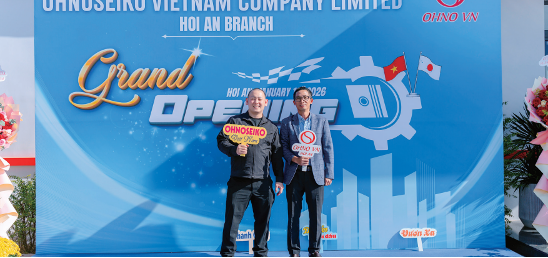
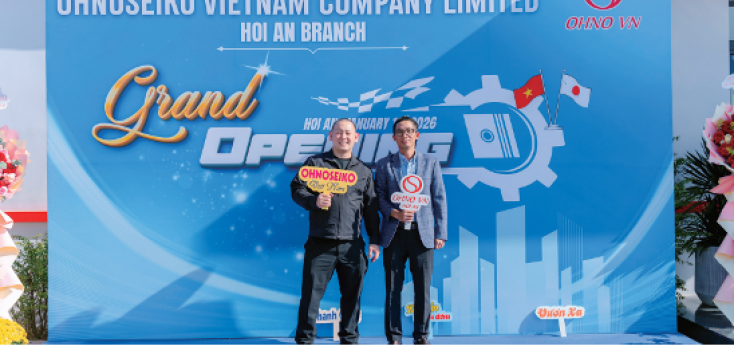
Mr Ohno Ryutaro (Left) and Mr.Pham Binh Duong (Right)
"To be honest, I wasn't without anxieties. However, after surveying the site and talking to everyone, I felt this was the right place for us,”
CEO Ohno said. The presence of Japanese trading companies in Da Nang is also a factor in assessing its future development potential. While large industrial zones in the North and South are operating at full capacity, and only locations far from the airport to choose, they also considered the trend of central Vietnam attracting attention as a new industrial hub.
The completion of the second factory in Hoi An is positioned not simply as “a solution to land acquisition problems”, but also as a strategic base for the next phase of growth, encompassing the entire country of Vietnam.
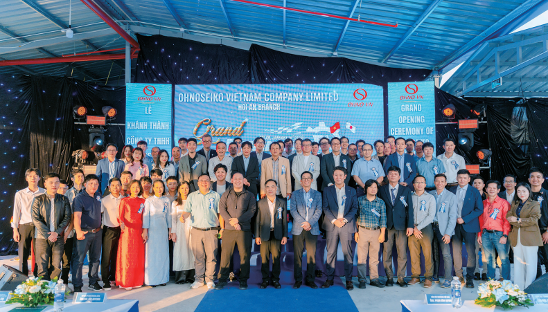
Hoi An factory was officially inaugurated on January 16, 2026.
The goal of the two-factory system with a divided processing area
The goal of the two-factory system is not simply to expand production capacity. Rather, it lies in restructuring the system by dividing the processing areas between two factories in Ho Chi Minh City and Hoi An, based on role assignments.
The Ho Chi Minh City factory will primarily handle complex processing stages, including heat treatment and plating, and projects requiring high technical expertise. Backed by accumulated equipment and technology, the factory has demonstrated strength in processing single-product items and urgent requirements. Meanwhile, the Hoi An factory is planned to handle medium size lots and larger-volume production projects, focusing on processing raw materials using processing centers.
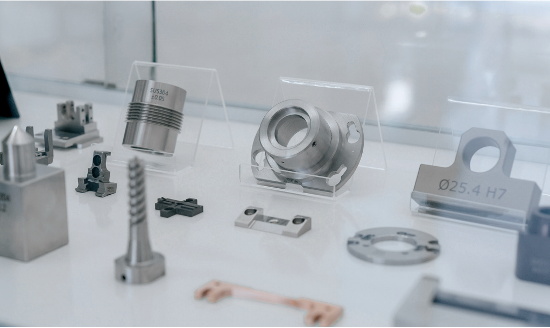 Specialized in machining jigs, machine parts, prototypes, and more
"We'll do whatever you can handle." This approach has helped Ohnoseiko build a reputation for processing a wide variety of products, including small quantities and single items. However, areas where this method cannot be handled are gradually becoming apparent. In particular, price discrepancies with Chinese companies, which focus on selective sourcing and concentrated supply, are emerging as a challenge in raw material processing and mass production.
At the headquarters in Japan, a large amount of work, especially raw material processing and large-scale projects, was outsourced to China. The idea of handling these projects in Vietnam led to the design of the Hoi An factory's role." Clearly separating the raw material base from mass-produced goods helps to clearly define the direction of equipment investment and process design, thereby easily improving price competitiveness.
Another objective is to diversify the procurement structure. "Considering the risks from China, we need to further strengthen our presence in Vietnam." This realization also influenced the decision to establish a second processing facility in central Vietnam.
Even with the division of roles, the quality control philosophy remains unchanged. The Hoi An factory will also utilize inspection equipment such as 3D measuring machines and will operate under the same quality control standards as the Ho Chi Minh City factory. Despite the dispersion of production facilities, the company's commitment to "Japanese quality in Vietnam" remains unchanged. The two-factory system can be seen as a strategic restructuring to advance the company's manufacturing to the next stage.
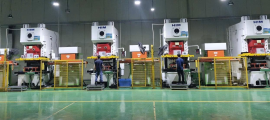
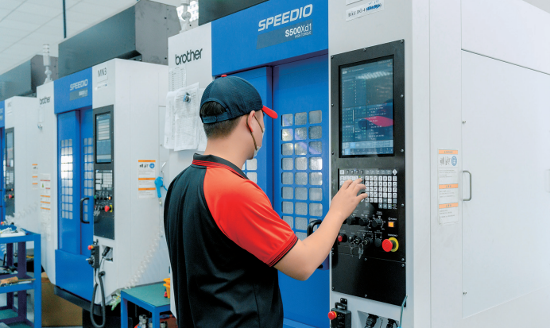 Modern equipment and a team of skilled technicians ensure high precision in machining
Expanding business domain centered on the Japanese Market
Currently, approximately 50% of sales are destined for Japan. The remainder consists of approximately 20% in Vietnam and 30% in Europe and the Americas, demonstrating steady expansion into markets outside of Japan. While primarily focused on jigs and fixtures, the company caters to diverse sectors without being biased towards any particular industry.
Initially, the policy of the factory in Vietnam was to focus on production for the headquarters in Japan. However, with Mr. Ohno's appointment as CEO in 2019, the policy changed. "We realized that expanding our business scope in the Vietnamese market would strengthen the factory's capabilities." From this thinking, they began seriously engaging in domestic sales activities. As a result of developing customers through exhibitions and introductions, their customer base has significantly changed over the past 5-6 years.
When asked about the challenges of doing business in Vietnam, CEO Ohno said:
"Honestly, I didn't find it too difficult because Mr. Duong is carefully observing and monitoring the situation."
CEO Duong was the company's first intern. He was given the opportunity to study in Japan thanks to his excellent academic achievements at university. The idea of establishing a factory in Vietnam became concrete when he was preparing to return home after completing his training in Japan.
"Although Vietnam is a pro-Japanese country, more importantly, meeting the right person is even more important. It was the encounters with people that came first. I don't think our expansion into Vietnam could have become a reality without Mr. Duong."
His assessment of local talent was also very frank. CEO Ohno highlighted the ingenuity and high learning spirit characteristic of Vietnamese people. He argued that their growth accelerates through their work experience in Japan, and this is reflected in metrics such as productivity and quality.
This established system provided the foundation for broadening the scope of management decisions. Although he faced the COVID-19 pandemic shortly after assuming the CEO, the expansion of their sales area prior to the pandemic ultimately supported business continuity. Diversifying the markets also helped reduce their dependence on specific countries or customers.
Their talent development system has also been consistently maintained since the company's founding. Future leadership candidates are assigned to the headquarters in Japan for two to three years, where they learn Japanese production philosophy and work processes through practical experience. Based on this experience, they return to Vietnam to take on the role of leading the next generation.
CEO Ohnoseiko envisions the future of its business in Vietnam as follows:
"In the next 10 or 20 years, Vietnam has the potential to become our global expansion hub. In fact, in the future, Japan may even receive orders from Vietnam."
He plans to develop Vietnam not merely as a production base, but as the core of his sales and business development operations.
The second factory in Hoi An is not just a strategic move. With these two facilities as a foundation, the company is moving to the next stage: automation to improve operational efficiency, new product development, and comprehensive expansion into the European and American markets. Developing talent, clarifying roles, and expanding the base – Ohnoseiko Vietnam's challenges have entered a new phase.
_____
Ohnoseiko Vietnam Co., Ltd
Lot S-2, Road 7, Long Hau IP, Can Giuoc, Tay Ninh
Tel: +84 (28) 3873 4967
Email: phambinhduong@ohnoseiko.vn
HOI AN BRANCH
Lot CN1-1, Thanh Ha Industrial Park, Hoi An Tay Ward, Da Nang City