


(TBTCO) - Russia's leading automaker, Avto VAZ, is exploring opportunities to enter the Vietnamese market. The company is currently sending car models to Vietnam for inspection and certification, paving the way for their export to this new market.
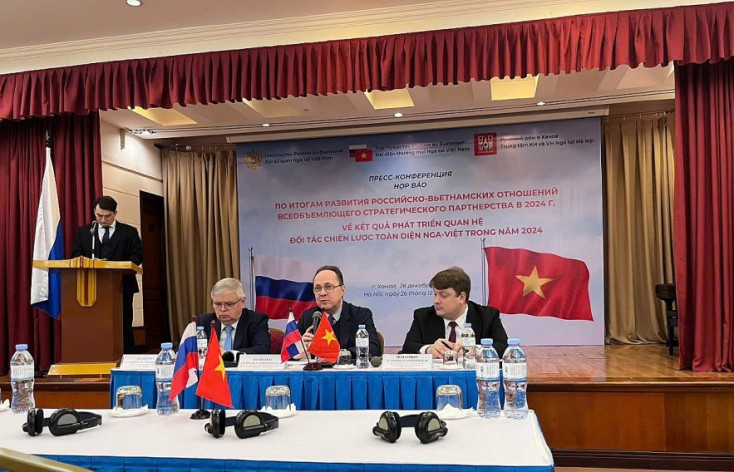
This information was shared by Mr. Viacheslav Kharinov, Head of the Russian Trade Representative Office in Vietnam, during a press conference on December 26 in Hanoi, which reviewed the results of the comprehensive strategic partnership between Russia and Vietnam in 2024.
Positive Trade Growth Between Vietnam and Russia
According to Mr. Viacheslav Kharinov, despite the complex international situation, the trade growth between Vietnam and Russia has shown a positive trajectory in both traditional products and new product lines. This includes increased business activity, notable achievements, and potential in a range of joint projects spanning multiple sectors.
Data from Vietnam Customs indicates that trade turnover between the two countries reached 4.15 billion USD in the first 11 months of 2024. Of this, Russian exports to Vietnam amounted to 2.03 billion USD, while Vietnam’s exports to Russia were 2.12 billion USD. By comparison, in 2023, the figures were 3.6 billion USD, 1.9 billion USD, and 1.7 billion USD, respectively.
An example of Russia's localized production in Vietnam is the GAZ Thanh Dat automobile assembly plant, established in 2019 with the participation of both governments. Over the past five years, GAZ-branded products have steadily strengthened their position in the Vietnamese market and expanded their exports to other regional markets.
Regarding the export of Russian automobiles to Vietnam, Mr. Kharinov stated that Vietnam is an attractive market. Russian vehicles can fully meet the demands of the Vietnamese market and compete effectively, especially in niche areas such as off-road vehicles for remote, rugged areas. This niche market is being studied by Russian enterprises for potential exports to Vietnam.
The Russian trade representative also confirmed that Avto VAZ has sent nine car models to Vietnam for inspection and certification as part of preparations for exporting these vehicles to Vietnam.
Expanding Cooperation Across Various Sectors
Discussing the results of the comprehensive strategic partnership between Russia and Vietnam in 2024, Ambassador Bezdetko expressed satisfaction with the proactive expansion of bilateral relations at various levels, including the highest levels of leadership.
Both sides have prepared a comprehensive plan for cooperation development between Russia and Vietnam up to 2030. This plan includes roadmaps to enhance collaboration in trade and investment, industry, energy, transportation, information and communication technology, science, and education.
Agreeing that the potential for Vietnam-Russia cooperation remains untapped, Ambassador Bezdetko emphasized that opportunities for collaboration across all sectors are vast due to the comprehensive strategic partnership between the two countries.
Adding to this, Mr. Viacheslav Kharinov noted that the robust bilateral relationship and high-level political trust contribute significantly to the development of mutually beneficial business cooperation between the two nations.
Last year, during the 24th session of the Vietnam-Russia Intergovernmental Committee on Economic, Trade, and Scientific-Technical Cooperation, the two sides discussed the effective implementation of the Free Trade Agreement between the Eurasian Economic Union and Vietnam, as well as feasible measures to increase bilateral trade turnover by 2025.
Russia plans to expand transport corridors, support the establishment of overseas industrial clusters, industrial zones, trade centers, and logistics hubs. This includes the Vietnam-Russia Industrial Park, located at the major logistics center in northern Vietnam—Hai Phong Port.
According to Mr. Kharinov, in addition to the automobile industry, other significant potential areas for industrial cooperation between Russia and Vietnam include medical and pharmaceutical industries, as well as information technology.