

With a goal of raising bilateral trade turnover to 20 billion USD by 2025, Vietnam and India aim to boost collaboration in renewable energy, green agriculture, green infrastructure, and emerging technologies.
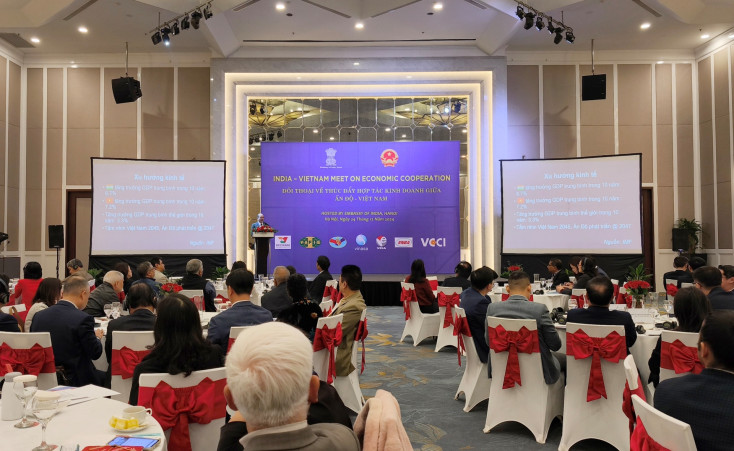
On December 24, the Embassy of India, in collaboration with Vietnam's Ministry of Industry and Trade, hosted a dialogue on Vietnam-India business cooperation.
In his opening remarks, Sandeep Arya, the Indian Ambassador to Vietnam, noted the significant progress in bilateral trade between the two nations.
Over the past decade, bilateral trade has grown at an average annual rate of 11%, reaching 14.3 billion USD. Indian exports to Vietnam grew at an average of 7.2% annually, hitting 5.9 billion USD, while Vietnamese exports to India rose by 14.8% annually to reach 8.4 billion USD. The overall trend is positive.
India's key exports to Vietnam include food products; auto parts, electrical equipment, and machinery; animal products; steel, aluminum, and their derivatives; pharmaceuticals and chemicals; and seafood.
Major Vietnamese exports to India comprise electronics (devices, components, LED lights); steel, copper, and related products; solar panels; chemicals and plastics; electrical equipment, components, and batteries; coffee, spices, rubber, and footwear.
Indian investment in Vietnam has also witnessed rapid growth, reaching 2.2 billion USD in 2024, with an average annual growth rate of 15.8% over the past decade. Ongoing discussions are underway in infrastructure, power, and other sectors.
Highlighting the potential for future trade and investment, Ambassador Arya identified agriculture, chemicals, electricity, electronics, gems and jewelry, supply chain integration in textiles, electronics, and automotive sectors, as well as collaboration in infrastructure, environment, renewable energy, defense, IT, software, and digital services as promising areas for cooperation. Emerging technologies were also emphasized as key areas for bilateral engagement.
Strengthening partnerships in new areas, green transition, and digitalization
Nguyen Thi Thu Ha, General Director of Invest Global under the Association of Foreign-Invested Enterprises, emphasized the strong and sustainable partnership Vietnam and India have cultivated over 50 years. Since the two nations elevated their relationship to a Comprehensive Strategic Partnership in 2016, several new areas of cooperation have emerged, including renewable energy, sustainable agriculture, environmental management, carbon credit exchange, and innovation in financial technology and digital payments.
In renewable energy, India, a global leader in solar energy production with significant projects like Solar Park and the International Solar Alliance (ISA), presents opportunities for collaboration with Vietnam. With its vast potential in solar and wind energy, Vietnam offers a promising avenue for technology transfer, investment, and regional supply chain development.
In green technology and technology transfer, including biotechnology, materials science, ocean development, marine research, pharmaceuticals, and medical devices, India can share its expertise and technology, while Vietnam can serve as a production hub for Southeast Asia.
For sustainable agriculture, the two countries have agreed to open their markets for Indian grapes to Vietnam and Vietnamese pomelos to India. Both nations, as major agricultural producers, have great potential to collaborate in applying green technologies such as organic farming, water conservation, and renewable energy use in agricultural production.
In waste management and the circular economy, India has implemented numerous innovative urban waste management initiatives, with successful models that can be shared with Vietnam. Advanced technologies developed by India, such as converting waste into energy, biogas production, and RDF (Refuse-Derived Fuel) technology, offer practical solutions for Vietnam to address its growing urban waste problem.
In green urban infrastructure development, VinFast has pioneered the green transportation market in India, the world’s third-largest automotive market, by investing 500 million USD to build an integrated electric vehicle manufacturing plant with an annual capacity of 150,000 vehicles, creating around 3,500 jobs.
Invest Global representatives highlighted that the Vietnamese government is planning to invest in high-speed rail, national rail, and urban railway infrastructure from 2025 to 2045, with a total estimated investment of 168 billion USD. This presents a significant opportunity for leading Indian construction corporations.
Regarding policy recommendations to enhance Vietnam-India trade and investment relations, Nguyen Thi Thu Ha stressed the need for both governments to expedite agreements on renewable energy, sustainable agriculture, environmental management, carbon credit exchange, and innovation in financial technology and digital payments. She also called for a bilateral Vietnam-India Free Trade Agreement, which would foster long-term, sustainable cooperation in advancing a green economy, yielding mutual benefits in investment, trade, and environmental development.