

Known for their high-precision machining, OHNOSEIKO Vietnam has taken another major step forward. The company installed a Makino DA300 5-axis machining center at their Ho Chi Minh plant and recently began full-scale operation. By adding 5-axis machining to the precision-processing expertise they have built over the years, OHNOSEIKO Vietnam has strengthened their ability to serve fields requiring advanced machining, including aerospace, semiconductors, medical devices, and EV-related applications.
Shorter Setups and More Stable Precision
The newly installed DA300 is a vertical 5-axis machining center developed for precision component machining. It is equipped with a high-speed spindle capable of up to 20,000 min⁻¹ and highly rigid A and C axes, suppressing vibration even at high rotational speeds and achieving high positioning accuracy. The maximum workpiece size is 450 mm in diameter and 400 mm in height, enabling the machining of complex three-dimensional geometries.
The greatest advantage of 5-axis machining is the ability to continuously machine a workpiece from multiple directions after a single setup. With conventional 3-axis machining, the workpiece must be reoriented and the origin reset for each machining face. This not only increases setup time but can also introduce variation in positioning accuracy.
“With a 5-axis machine, once the workpiece is set, the table rotates and the machine can complete the job. Setup is faster, and quality is more stable.”
The comment comes from Pham Binh Duong, President of OHNOSEIKO Vietnam.
Reducing the number of setups helps minimize positioning errors and also improves machining efficiency. For a company that specializes in prototypes, jigs and fixtures, and high-mix low-volume production, the benefits are substantial.
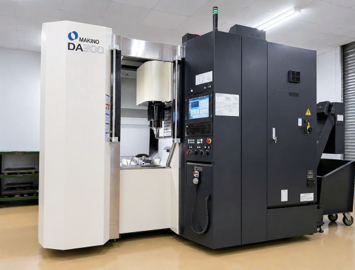
DA300 5-axis vertical machining center
Expanding the Range of High-Difficulty Machining
The full value of a 5-axis machine becomes apparent when machining parts with complex three-dimensional surfaces. One example President Duong cites is an aircraft turbine. Because turbine blades are formed from intricate curved surfaces, they must be machined precisely while the tool approaches from multiple directions, making 5-axis machining essential.
When complex shapes are machined on a 3-axis machine, multiple setups are required for the different faces. Whether tight tolerances can be maintained consistently therefore depends heavily on the operator’s skill.
With this equipment investment, the company has significantly increased their capability to handle difficult parts and can now respond more flexibly to sectors with stringent quality requirements, including medical devices and EV applications. In recent years, in addition to semiconductor-related work, the company has seen more orders for prototype parts and precision jigs for robot development projects in the United States. In these fields, customers require not only high finishing accuracy but also the ability to supply prototypes quickly on short lead times.
Advancing Automation to Raise Productivity
The investment goes beyond introducing a 5-axis machining center. OHNOSEIKO Vietnam is now putting into practical operation an automated system that combines the DA300 with a robot, automating the process from material loading and machining through to unloading finished parts. With unmanned nighttime operation also under consideration, the company is working to improve productivity and address labor shortages.
“People can focus on higher-value-added work such as programming,” President Duong says.
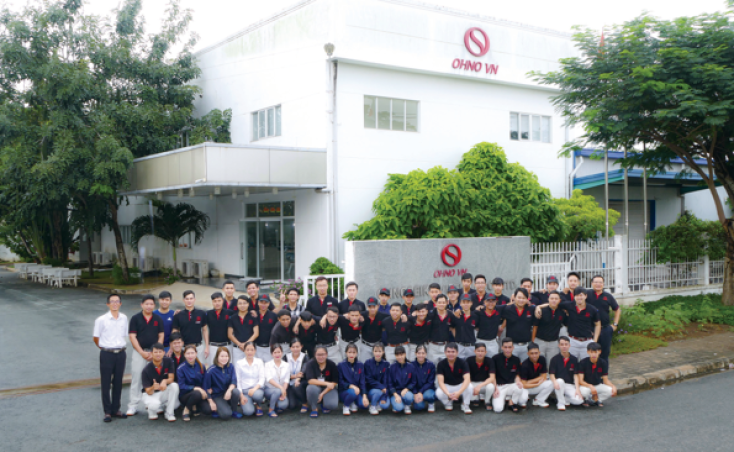
Since starting operations in 2013, OHNOSEIKO Vietnam has pursued “Japanese quality in Vietnam” through high-mix low-volume precision machining. With this latest investment, they are further strengthening their competitiveness through the twin pillars of high-difficulty machining and automation. The company aims to continue expanding their business while responding to the evolving needs of modern manufacturing sites.