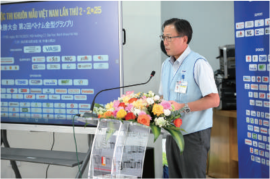


In addition to increasing the exchange of goods and services, the CPTPP agreement also presents an opportunity for Vietnam to attract FDI from CPTPP partners, thanks to the elimination of 95% of customs duties in a market of over 500 million people with a combined GDP exceeding 10 trillion USD.
The Ministry of Industry and Trade has assessed that five years after the Comprehensive and Progressive Agreement for Trans-Pacific Partnership (CPTPP) came into force in January 2019, one of its notable benefits has been the attraction of foreign direct investment (FDI).
In addition to facilitating the exchange of goods and services, the CPTPP provides Vietnam with a significant opportunity to attract FDI from its member countries. This is largely due to the elimination of 95% of customs duties in a market comprising over 500 million people and a total GDP exceeding 10 trillion USD. This market represents approximately 13.5% of global GDP and 14% of global trade, including major economies such as Japan, Canada, Australia, and Singapore.
Since the agreement took effect, Vietnam’s ability to attract FDI from CPTPP countries has shown steady improvement. In 2019, the country attracted approximately 9.5 billion USD in FDI from CPTPP nations. By 2022, this figure had grown to nearly 11.5 billion USD, an increase of 2.6 billion USD compared to 2021. The number of new projects reached 577, up by 77 compared to the previous year. Singapore and Japan emerged as the largest investors, with registered capital of 6.4 billion USD and 4.7 billion USD, respectively.
In the first nine months of 2023, Vietnam granted investment certificates for 2,254 new projects—a 66.3% increase compared to the same period in 2022—with total registered capital exceeding 10.23 billion USD. Of this, two CPTPP members accounted for 67% of the total investment: Singapore led with over 3.98 billion USD, while Japan ranked third with nearly 2.9 billion USD. Looking ahead, FDI inflows from CPTPP countries are expected to continue growing, particularly from Brunei, Malaysia, Singapore, Japan, and Australia—traditional trade and investment partners of Vietnam.
With 16 free trade agreements (FTAs) already signed, Vietnam has become increasingly attractive to CPTPP investors, especially those from countries with extensive FTA participation, such as Singapore, Japan, and Australia.
Following these FDI inflows, Vietnam and Japan have developed specific plans for technology transfer and cooperation. Under the framework of the Vietnam-Japan Joint Committee on Cooperation in Industry, Trade, and Energy, the Ministry of Industry and Trade is collaborating with Japan's Ministry of Economy, Trade, and Industry to formulate a plan for cooperation in the automobile and supporting industries in the coming years.
Singapore also remains a leading investor in Vietnam. Over the years, investment from Singapore has been guided by a strategy emphasizing economic cooperation and technology transfer across five key pillars: energy connectivity, sustainable development, infrastructure, digital innovation, and multi-faceted connectivity, including education, finance, IT and telecommunications, tourism, investment, trade, and transport.
In the future, efforts to promote FDI from Japan and Singapore, as well as other CPTPP countries, will focus on enhancing cooperation and technology transfer in critical areas such as the digital economy, infrastructure development, sustainable practices, climate change mitigation, and multi-faceted connectivity in trade, investment, finance, transport, and tourism. These sectors are expected to remain priorities for FDI enterprises in the years ahead.
Experts emphasize that to fully capitalize on opportunities for attracting FDI, Vietnam’s investment promotion activities must increasingly target potential investors, especially large multinational corporations. This approach will enable Vietnam to leverage the advantages of next-generation free trade agreements, participate in global supply chains, and maximize the potential of the CPTPP market.