

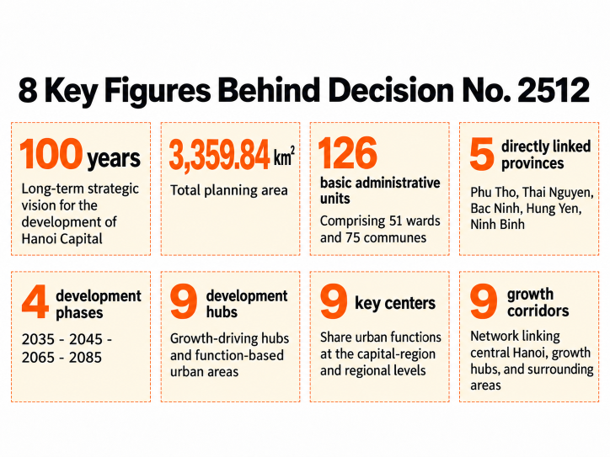
On May 13, 2026, the Hanoi People’s Committee issued Decision No. 2512/QĐ-UBND approving a comprehensive capital master plan looking 100 years ahead. What this decision presents is not merely a long-term vision for urban space in the coming century. Through a multi-polar urban model, transport corridors, and the development of new technology hubs, it also sets out a framework for redefining the roles of Hanoi and the surrounding industrial regions.

Urban Planning Will Reshape Manufacturing
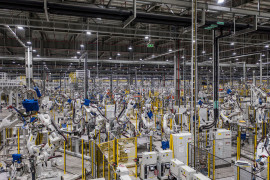
Decision No. 2512 envisions Hanoi taking on high-value-added functions such as research and development (R&D), business management, advanced talent development, and logistics, while production networks expand across the whole northern region.
From January to May 2026, total foreign investment approved in Vietnam through new registrations, capital increases, share acquisitions, and capital contributions reached USD 24.8 billion, up 34.9% year on year. Of this, manufacturing accounted for USD 15 billion, or 60.5% of the total, making it by far the largest investment destination. Given that foreign capital remains heavily concentrated in manufacturing, changes in Hanoi’s industrial layout, transport infrastructure, logistics, human resources, and environmental standards are likely to have a major impact on production networks across northern Vietnam.
A Broad Urban Vision Beyond the Capital Region
Decision No. 2512 does more than outline an urban-development direction. It integrates a broad set of policies covering transportation, industry, logistics, science and technology, the environment, digital transformation (DX), human-resource development, and interregional linkage.
One notable feature is that the scope of study and planning extends beyond the capital region to the broader economic corridors of northern Vietnam. This positions Hanoi as a core city that links urban functions, production, and services across provincial boundaries. The concept also reflects the reality that northern supply chains have already developed beyond administrative borders, connecting manufacturing clusters in places such as Bac Ninh, Thai Nguyen, Hung Yen, and Phu Tho with Hanoi’s headquarters functions, Noi Bai International Airport, and Hai Phong Port.
Ambitious Economic Growth Targets
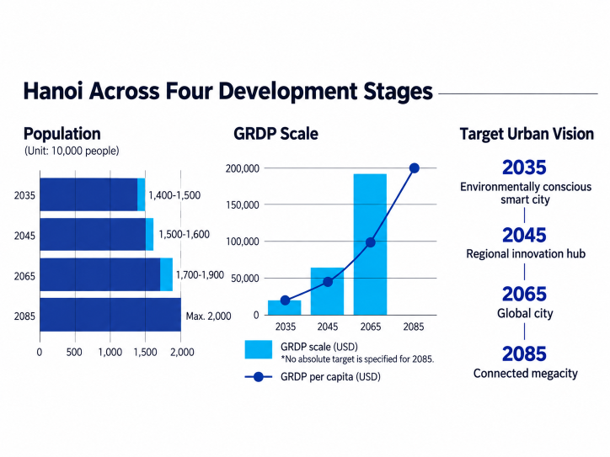
Decision No. 2512 sets a target for Hanoi’s gross regional domestic product (GRDP) to grow by more than 11% annually on average between 2026 and 2045. The city’s GRDP is projected to reach approximately USD 200 billion by 2035, about USD 640 billion by 2045, and roughly USD 1.92 trillion by 2065. Per-capita GRDP is projected to rise to USD 20,000 by 2035, USD 45,000 by 2045, and around USD 90,000 by 2065. For 2085, the plan presents a qualitative rather than absolute target.
These targets point to a transition toward a high-value-added economy in which productivity gains, advanced technology, data utilization, highly skilled human resources, and innovation become the main drivers of growth.
From Monocentric Concentration to a “Multi-Polar, Multi-Center” Model
One of the core pillars of Decision No. 2512 is a shift away from the traditional urban model, in which population, employment, and services are concentrated in the central city, toward a “multi-polar, multi-center, multilayer, and overlapping” urban structure.
“Multi-polar and multi-center” refers to the distribution of industrial and social functions across multiple locations in order to ease excessive concentration in the inner city and create new growth engines. “Multilayer and overlapping” means making effective use of vertical space—including underground, surface, and airspace—while balancing history and culture, ecosystems, society, economy, and technology.
The basic spatial framework adopts a “9-9-9” model consisting of nine development hubs, nine key centers, and nine growth corridors, with urban functions allocated according to the role of each area. The northern zone is expected to focus on aviation, international linkage, logistics, and high-tech industry, while the eastern zone is positioned to connect commerce, inland container depots (dry ports), and seaport-related functions.
Ring roads, radial expressways extending from the city center, urban railways, and interregional railways will form the backbone that links these development poles with central Hanoi and surrounding localities.
Policy Foundations Supporting Growth
Science and technology, innovation, and digital transformation are positioned as pillars of the growth strategy. At Hoa Lac Hi-Tech Park, infrastructure is being developed for R&D, demonstration testing, and talent development. In the city itself, investments are being directed not only toward railways, roads, and bridges, but also toward data infrastructure and science-and-technology platforms.
The aim of Decision No. 2512 is not uncontrolled urban sprawl in which the city and industrial facilities expand chaotically. Instead, it seeks to strengthen Hanoi’s role as the core city of northern Vietnam by reallocating urban functions, preserving the historic center, and creating new growth poles. For companies, the key question is no longer simply whether Hanoi is the best production base, but rather what role Hanoi will play within the broader production network of the North.
Hanoi Moves from Vision to Execution
At the “Capital Master Plan Announcement and Investment Promotion Conference” held on June 29, 2026, Hanoi announced 276 investment-attraction projects. These projects fall broadly into the following five fields:
- Transport and logistics: urban rail, bridges and roads, inland waterway ports, inland container depots (ICDs), bus terminals, and parking facilities.
- Environmental and technical infrastructure: collection and treatment of wastewater and solid waste, as well as waste-to-energy projects.
- Industry and high technology: industrial parks, industrial clusters, and research/production projects in Hoa Lac Hi-Tech Park.
- Urban development and housing: new urban areas, social housing, and housing development in newly planned districts.
- Education, healthcare, culture, and sports: medical complexes, education and training facilities, parks, and public facilities.
Construction of the core infrastructure supporting this urban structure is already moving forward. Work on Ring Road No. 4 has accelerated across Hanoi, Hung Yen, and Bac Ninh. As of mid-2026, Hanoi had set a target of completing the frontage roads by September 2026, and roadbed and asphalt paving were progressing in sections where land acquisition had already been completed.
Construction of Tu Lien Bridge and its connecting roads is also advancing. By the end of May 2026, land acquisition had reached about 98.4%, and work on the main bridge, interchanges, and northern Red River access roads had moved into full-scale construction. Completion of the bridge structure is targeted for the second quarter of 2027.
On June 22, 2026, construction began simultaneously on five urban railway lines. Their total length is about 303.5 kilometers, with an estimated total investment exceeding VND 1,315 trillion. Industrial projects are also moving into implementation. At Hoa Lac Hi-Tech Park, some high-tech manufacturing projects have entered the execution stage, and total registered investment in industrial zones within the park had reached USD 4.85 billion by the first half of 2026. One notable case is a semiconductor-component plant launched in Hoa Lac, with a planned site area of approximately 27 hectares and a total investment of about VND 19.63 trillion.
How Will Northern Manufacturing Change?
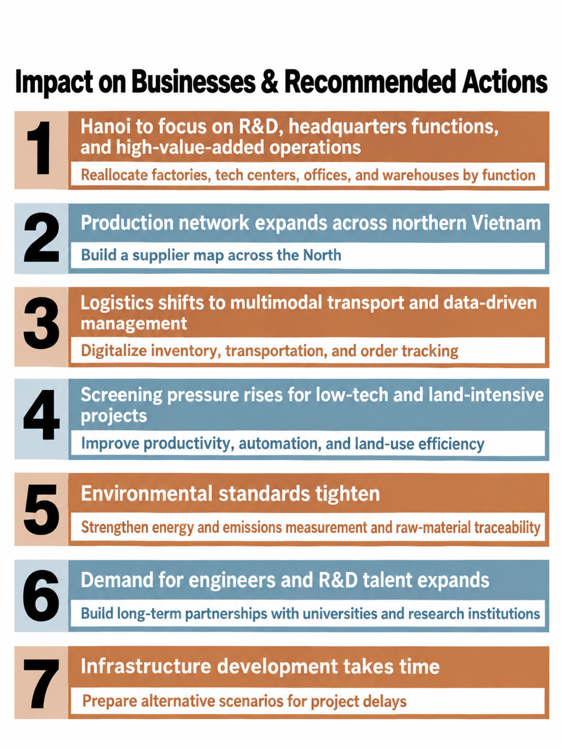
Decision No. 2512 will also have a major impact on the manufacturing supply chain in northern Vietnam. These changes can be organized into four main perspectives.
1. Hanoi Will Become a High-Value-Added Hub
The plan signals a selective attraction policy focused on high-tech and low-environmental-impact sectors such as electronics, semiconductors, artificial intelligence (AI), supporting industries, logistics, and digital technology. Under this direction, Hanoi is likely to evolve from a place where production activities are concentrated into a hub where R&D, design, testing and validation, procurement, supplier management, finance, data management, and talent development are concentrated.
By contrast, production activities requiring assembly processes or large land areas are likely to keep expanding in surrounding provinces such as Bac Ninh, Thai Nguyen, Hung Yen, Phu Tho, and Ninh Binh. As a result, a locational pattern in which “management and engineering functions are in Hanoi, while factories are in surrounding provinces” will become increasingly common.
What companies need is not to concentrate every function in a single location, but to build a broad-area business network by combining the optimal location for each part of the value chain.
2. Logistics Will Shift Toward Multimodal Systems
As ring roads, interregional railways, ICDs, and access corridors to airports and seaports are developed, companies will have more transportation options, and freight will become less dependent on passing through central Hanoi. Once these infrastructures are integrated, firms will be able to connect factories, warehouses, airports, and ports more efficiently. The geographic range from which suppliers can be selected will expand, and dependence on specific routes or transport modes will decline.
It is important to note that the plan emphasizes not only increased transport capacity or warehouse area, but also smart logistics, automation, and data-driven operational management. For that reason, the competitiveness of logistics providers will no longer be measured merely by the number of vehicles they own or the size of their warehouses. The ability to manage inventory, track cargo in real time, forecast demand, optimize transport routes, and control emissions will become more important than ever.
3. The Market Will Demand “Quality” Rather Than “Quantity”
Decision No. 2512 stresses the need to strengthen linkages among private companies, state-owned enterprises, and foreign-invested enterprises (FDI companies) in order to build a sustainable supply chain. While this is positive news for supporting industries, it also suggests that future investment attraction will shift from “expanding quantity” to “selecting quality.”
According to JETRO’s 2025 survey, 56.9% of Japanese companies in Vietnam plan to expand their business within the next one to two years. Meanwhile, the local procurement rate of raw materials and parts among Japanese manufacturers in Vietnam remains only 38.1%, below the ASEAN average of 42.9%.
These two figures may appear contradictory at first glance, but in reality they indicate that while demand for production expansion remains high, the capability level of local suppliers has not yet risen sufficiently to match that demand. This gap represents a major business opportunity for companies involved in precision machining, molds and dies, electronic components, automation equipment, factory software, and industrial maintenance.
4. Green Transformation and Digitalization Will Become the New Standard
In the future, it will no longer be enough simply to meet product technical specifications. Companies will also be asked to provide data on raw materials, energy, chemicals, water resources, and greenhouse-gas emissions used in the production process. This means factories will need production-line-level energy measurement systems, water and waste management, traceability of raw materials, carbon-management software, and supply-chain visibility platforms.
Suppliers, too, will need to standardize how environmental and production-related data are collected and managed so that they can respond to the requirements of parent companies and export markets. Although the initial investment burden may increase, these efforts can also create opportunities for international competitiveness by reducing material waste, optimizing energy use, and responding more rigorously to environmental standards.
What Companies Should Prepare for Now
Optimal Placement of Factories, R&D, and Logistics Bases
Companies do not necessarily need to concentrate factories, R&D bases, warehouses, and headquarters offices in one place. Each function should be located based on land availability, cost, access to talent, distance to suppliers, access to ports and airports, utility supply, and environmental-treatment capacity. Hanoi is suited to technology centers, procurement departments, and headquarters functions, while large-scale production is often better located in industrial parks in surrounding provinces. For export warehouses, sites along logistics corridors connecting to Noi Bai International Airport and Hai Phong Port are strong candidates.
Building a Broad-Area Procurement Network
Rather than limiting suppliers to the vicinity of a factory, companies should evaluate a northern supply network that includes Hanoi, Bac Ninh, Thai Nguyen, Hung Yen, Phu Tho, Ninh Binh, and Hai Phong. Supplier databases should capture technical capability, production capacity, certifications held, delivery performance, dependency on imported materials, and responsiveness to environmental requirements.
Digitalizing Supply-Chain Management
When factories, warehouses, and suppliers are spread across multiple provinces and cities, companies need the ability to track inventory, orders, and transport conditions in real time. By using warehouse management systems (WMS), transport management systems (TMS), IoT, and data analytics, companies can identify delivery-delay risks early, improve allocation decisions, and optimize safe-inventory levels and the selection of multiple transport modes.
Early Development of Environmental Data
Rather than waiting until the reporting of energy and emissions data becomes mandatory, companies should begin measuring data by factory, production line, and product as early as possible. Priority actions include conducting energy audits, digitizing electricity, water, and raw-material data, reviewing environmental-treatment technologies, and adding emissions-related items to supplier-selection criteria.
Long-Term Investment in Technical Talent
As the source of competitiveness shifts from low-cost labor to technology and productivity, companies need to become more deeply involved in talent development than ever before. Collaboration with universities and research institutions should not be limited to recruitment; it can also develop into joint research, shared-use laboratories, supplier training, and collaborative work on production processes.
Preparing Multiple Infrastructure Scenarios
Companies should clearly distinguish between conceptual plans, approved projects, projects under implementation, and infrastructure already in operation. When drawing up investment plans, it is important to prepare alternative options in case railway, airport, or logistics-center projects are delayed, land and labor costs rise, or planned transport routes cannot be used as expected.
From “Location Advantage” to “Network Advantage”
The greatest change that Decision No. 2512 will bring to manufacturing may not necessarily appear in the number of new factories established within Hanoi itself. Rather, it lies in Hanoi’s transformation into the core of an interprovincial production network and into a hub where technology, talent, and logistics are concentrated.
Under this structure, large-scale mass-production functions will continue to be located in surrounding areas that have sufficient industrial land and industrial infrastructure. Hanoi, by contrast, will increasingly concentrate on high-value-added functions such as R&D, design, finance, data, talent development, and supply-chain management.
In the future, competitive advantage will not belong only to companies that own factories in good locations. It will belong to companies that can most efficiently connect R&D bases, factories, suppliers, logistics, energy, and export markets.
The strategic question companies must face is therefore not simply whether to invest in Hanoi or in surrounding provinces. What matters is how to leverage Hanoi’s technology and talent ecosystem while arranging each function of the value chain so as to maximize production capacity and logistics performance across the whole northern region.